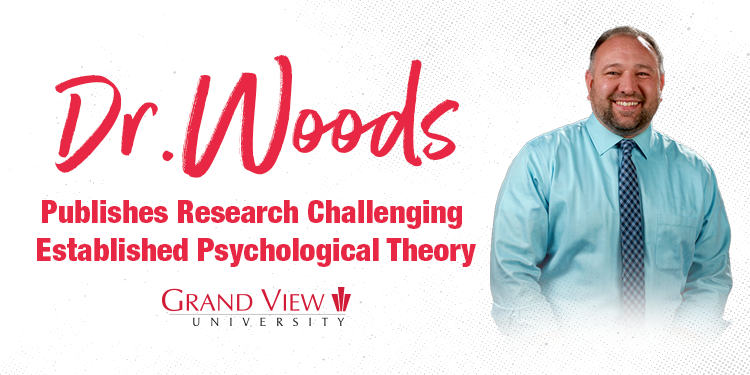
Dr. Woods Publishes Research Challenging Established Psychological Theory
October 19, 2026
Dr. Josh Woods, Professor of Psychology at Grand View University, and Dr. Paul Riesthuis ('16), an assistant professor at Erasmus University Rotterdam in the Netherlands, have published new research that challenges a widely held assumption about how repetition influences people's beliefs. Their findings, published in the international, peer-reviewed journal Consciousness and Cognition, contribute to a growing reconsideration of how one of psychology's most well-established phenomena applies to sociopolitical opinions.
For nearly five decades, psychologists have studied the illusory truth effect: the tendency for repeated information to be perceived as more truthful, regardless of whether it is actually true. This phenomenon has become an important part of scientific discussions about misinformation, political persuasion, and the formation of beliefs.
However, Woods and Riesthuis have found that the relationship between repetition and belief is considerably more nuanced than commonly assumed. Their newly published article, Limits of the Illusory Truth Effect for Social-Political Opinions: Evidence from Two Experiments and a Mini Meta-Analysis, presents findings from two preregistered experiments involving 457 participants, supplemented by a statistical synthesis of their findings and previous research.
Across both experiments, repeating sociopolitical opinions did not meaningfully increase participants' judgments of their truthfulness. Remarkably, this pattern held whether participants agreed with the opinions, disagreed with them, or expressed neutral positions. The findings identify an important boundary to the illusory truth effect, suggesting that a psychological process reliably demonstrated with factual statements does not necessarily operate in the same way when individuals evaluate subjective political and social opinions. Rather than simply extending existing theories, the research helps refine the scientific understanding of when and why repetition influences what people believe.
The international collaboration is particularly meaningful for Grand View University. Riesthuis, a 2016 Grand View alumnus who recently accepted an assistant professor position at Erasmus University Rotterdam in the Netherlands, continues his research partnership with Woods, who leads undergraduate research initiatives at Grand View. Their ongoing collaboration connects scholars across institutions and countries, demonstrating how research partnerships rooted in the Grand View community can contribute to international scientific discussions.
The implications extend well beyond laboratory research. As societies grapple with political polarization, misinformation, and the influence of repeated messages across digital media, understanding the conditions under which repetition does or does not influence beliefs is increasingly important. The findings do not suggest that repetition is powerless in political communication. Rather, they demonstrate that scientists must distinguish between different kinds of information before assuming that repetition will produce the same psychological effects.
By identifying these limits, Woods and Riesthuis are helping advance a more precise understanding of human belief formation and opening new questions about the psychological mechanisms underlying political and social judgments. Their findings contribute to an important scientific conversation at the intersection of cognitive and social psychology, illustrating how scientific projects like this one can refine influential theories and challenge assumptions about the human mind.
The article was recently published in Consciousness and Cognition, Volume 144, Article 104119.
Read the research.